Southwest Colorado is known for its nature-centric lifestyle, abundant open space, and small-town communities. One major benefit of life in the Rocky Mountains is the consistently good air quality.
How is Air Quality Rated?
The Air Quality Index (AQI) is the Environmental Protection Agency’s (EPA) rating system for measuring and reporting outdoor air quality. The AQI rating is broken down into six color-coded categories. The lower the number, the better the air quality.1
- Green represents “good” air quality, with AQIs between 0 and 50.
- Yellow includes AQIs between 51 and 100, which is considered moderate and generally satisfactory. Some sensitive groups, such as those with lung disease, asthma, or older adults, may feel the effects.
- Orange represents an AQI of 101 to 150, which typically doesn’t affect the general public, although it’s not ideal for sensitive individuals.
- Red, from 151 to 200, is considered unhealthy and dangerous for sensitive people, and may also begin to affect the general public.
- Purple (201 - 250) indicates the risk of health effects for all individuals.
- Maroon represents AQI levels above 300, which is considered an emergency air quality condition.
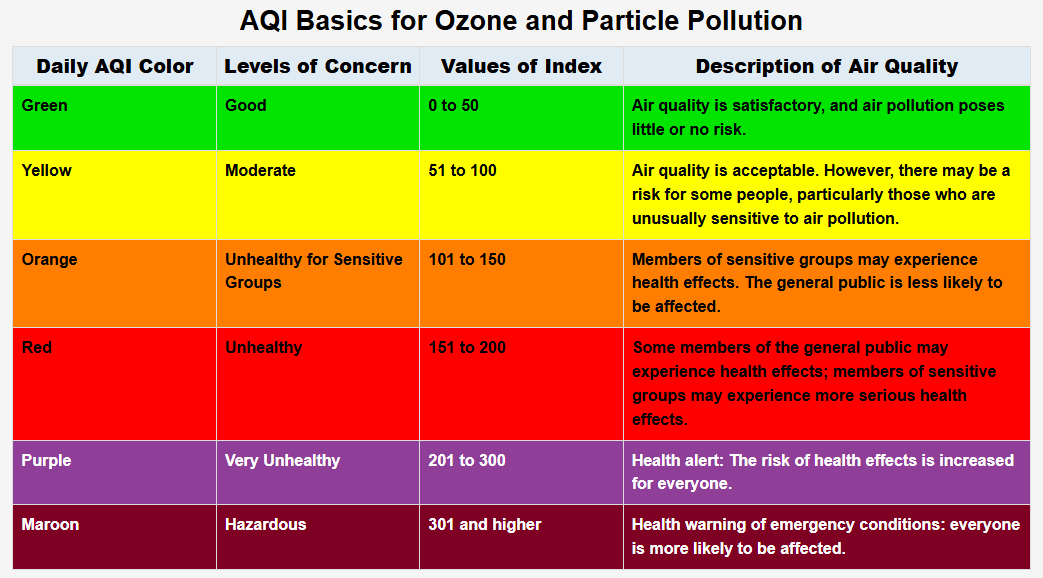
The AQI provides an easy reference for the public to understand the air quality in their area. When air quality is poor, people and animals can be affected and have symptoms including coughing, wheezing, eye irritation, phlegm production, decreased lung function, inflammation of the airways and lungs, bronchial hyperreactivity, and respiratory infections.2
What Affects Air Quality?
There are many factors that influence the overall air quality as well as air quality in a specific location. While some pollutants cause an immediate change in AQI, others accumulate over a longer period of time. Across the United States, the two primary categories of pollution are ozone (also referred to as smog) and particle pollution (solid or liquid particles such as soot, acid, pollen, and dust). The five major pollutants are ground-level ozone, particle pollution (also known as particulate matter or PM), carbon monoxide, sulfur dioxide, and nitrogen dioxide. These pollutants are monitored and regulated by the EPA.
Durango’s Air Quality
A smaller mountain community with a population of roughly 20,000, Durango, CO has consistently good air quality, typically in the 20s. Although we have less smog than bigger metropolitan areas, natural factors including elevation, wind, pollen, and wildfires can increase the Southwest Colorado AQI. Not only is the good air quality ideal for outdoor recreation, but also makes stargazing a favorite nighttime activity.
Air Quality in Real Estate
Good air quality in your home is important for long-term health and comfort. When looking at homes in the Durango area, insulation, HVAC systems, and elevation can all play a role in indoor air quality (IAQ). Other common items to consider include mold, smoke, pet odors, carbon monoxide, and radon. Some of these elements can be mitigated, while others may need ongoing monitoring and maintenance.
Our clean mountain air makes enjoying our trails, rivers, and mountains an unforgettable experience, and another reason why we love living in Southwest Colorado. As locals and RealtorsⓇ, let The Durango Team help guide you to the ultimate Colorado home.
1 “Aqi Basics.” AQI Basics | AirNow.Gov, AirNow.gov, U.S. EPA, www.airnow.gov/aqi/aqi-basics/. Accessed 3 Mar. 2026.
2 “Particle Pollution and Respiratory Effects.” EPA, Environmental Protection Agency, 6 June 2025, www.epa.gov/pmcourse/particle-pollution-and-respiratory-effects.